内容概述
本文提出一个经典几何问题:在不使用勾股定理及其逆定理或任何推论的前提下,证明 3-4-5 三角形是直角三角形。文章指出古埃及测量员可能用打有 11 个结的绳子(分为 12 等份)来构造 3-4-5 直角三角形,但并无文字证据表明他们知晓勾股定理。随后介绍了一种基于面积法的简洁证明:将四个 3-4-5 直角三角形与一个单位正方形拼成一个大正方形(面积为 25),从而推出斜边长为 5。该解法见于中国古代数学经典《周髀算经》,且可推广至任意直角三角形的勾股关系。
中文正文
20° 3-4-5 三角形问题
有报告说,古埃及的测量员会拿一根绳子来打 11 个结,把它等分为 12 节,通过这样来构造 3-4-5 直角三角形。因为没有文字证据说明古埃及人懂得毕达哥拉斯定理(哪怕它的一个特例),于是我们自然提出下面的问题:不用毕达哥拉斯定理和它的任何相关结论,如何证明 3-4-5 三角形是直角三角形?读者也许有兴趣来试试。千百年来,我们有了很多证明方法。图 3 大致说明了一个特别简单的方法。四个边长分别为 3 和 4 的直角三角形紧贴在一个单位正方形的四边,形成一个面积等于 25(平方单位)的正方形。这意味着直角三角形斜边的长为 5,从而 3-4-5 三角形是直角三角形。这个解法见《周髀算经》(The Arithmetical Classic of the Gnomon and the Circular Paths of Heaven),一般认为是最古老的中国古代数学经典,很容易推广去得到任意直角三角形的毕达哥拉斯关系。
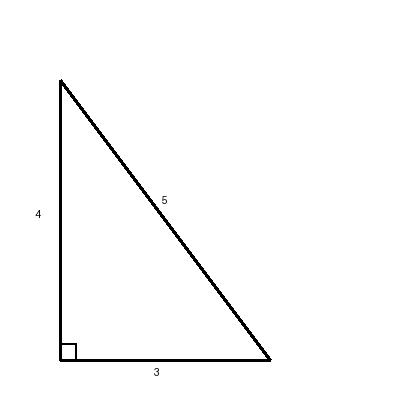
图 3 四个 3-4-5 直角三角形与中心单位正方形拼成大正方形(面积 = 25)
英文正文
20° The 3-4-5 triangle problem. There are reports that ancient Egyptian surveyors laid out right angles by constructing 3–4–5 triangles with a rope divided into 12 equal parts by 11 knots. Since there is no documentary evidence to the effect that the Egyptians were aware of even a particular case of the Pythagorean theorem, the following purely academic problem arises: Show, without using the Pythagorean theorem, its converse, or any of its consequences, that the 3–4–5 triangle is a right triangle. The reader may care to try to solve this problem. Many different solutions have been given over the years. A particularly simple solution can be effected based on Figure 3, which shows four right triangles with legs of 3 and 4 units, along with a unit square, making up a square of 25 square units of area. This means that the hypotenuse of a right triangle with legs of 3 and 4 units is 5 units long, and it follows that a 3–4–5 triangle is a right triangle. This solution is found in the Chou-pei Suan-king (The Arithmetical Classic of the Gnomon and the Circular Paths of Heaven), a work generally regarded as the oldest of the ancient Chinese mathematical classics. The solution is easily generalized to obtain the Pythagorean relation for an arbitrary right triangle.
英语学习拓展
常用词汇
surveyor音标/səˈveɪər/
测量员。
原文用法:"ancient Egyptian surveyors laid out right angles..."
lay out:布置,铺设,划定。原文用法:"ancient Egyptian surveyors laid out right angles by constructing..."
documentary音标/ˌdɑːkjuˈmentri/
文献的,文件的。
原文用法:"Since there is no documentary evidence to the effect that..."
converse音标/kɒnvɜːrs/
(逻辑学)逆命题。
原文用法:"...without using the Pythagorean theorem, its converse, or any of its consequences..."
consequence音标/ˈkɒnsɪkwens/
推论,结果。
原文用法:"...its converse, or any of its consequences..."
effect音标/ɪˈfɛkt/
效果;大意(在此短语中)。
原文用法:"no documentary evidence to the effect that..."(意为"没有……内容的文献证据")
arise音标/əˈraɪz/
出现,产生。
原文用法:"the following purely academic problem arises"
purely音标/ˈpjʊrli/
纯粹地。
原文用法:"the following purely academic problem arises"
effect音标/ɪˈfɛkt/
实现,达成。
原文用法:"A particularly simple solution can be effected based on Figure 3..."
leg音标/lɛg/
(直角三角形的)直角边。
原文用法:"four right triangles with legs of 3 and 4 units..."
hypotenuse音标/haɪˈpɒtənuːz/
(直角三角形的)斜边。
原文用法:"This means that the hypotenuse of a right triangle with legs of 3 and 4 units is 5 units long..."
generalize音标/ˈdʒɛnrəlaɪz/
推广,概括。
原文用法:"The solution is easily generalized to obtain the Pythagorean relation..."
arbitrary音标/ˈɑːrbɪtreri/
任意的。
原文用法:"...for an arbitrary right triangle."
gnomon音标/ˈnoʊmɒn/
圭表(日晷的指针部件)。
原文出处书名:"The Arithmetical Classic of the Gnomon and the Circular Paths of Heaven"
同义词与近义词
对应核心词汇:surveyor
对应核心词汇:surveyor。
辨析:surveyor 最通用;measurer 更侧重"测量行为"本身;land-surveyor 特指土地测量员。
对应核心词汇:documentary
对应核心词汇:documentary。
辨析:documentary 强调"有文件/文献记录";written 强调"书面形式";textual 强调"文本性质"。
对应核心词汇:converse
对应核心词汇:converse。
辨析:在逻辑中,converse 指"逆命题"(交换条件和结论);inverse 指"否命题"(分别否定条件和结论);reverse 指"相反/颠倒"(通用词)。
对应核心词汇:arise
对应核心词汇:arise。
辨析:arise 较正式,常用于"问题/困难出现";emerge 侧重"从隐藏状态显现";occur 最通用。
对应核心词汇:generalize
对应核心词汇:generalize。
辨析:generalize 指从特殊到一般;extend 指扩大适用范围;extrapolate 指从已知数据外推到未知范围。
常用短语与固定搭配
- lay out:布置,规划,铺设。原文用法:"ancient Egyptian surveyors laid out right angles by constructing 3–4–5 triangles..."
- to the effect that:大意是,内容为。原文用法:"no documentary evidence to the effect that the Egyptians were aware of..."
- be aware of:知道,意识到。原文用法:"the Egyptians were aware of even a particular case of the Pythagorean theorem"
- care to do something:愿意做某事(常用于礼貌邀请)。原文用法:"The reader may care to try to solve this problem."
- based on:基于,以……为基础。原文用法:"A particularly simple solution can be effected based on Figure 3..."
- make up:组成,构成。原文用法:"...along with a unit square, making up a square of 25 square units of area."
- it follows that:由此可见,从而得出。原文用法:"...and it follows that a 3–4–5 triangle is a right triangle."
常用句式
- There are reports that...:有报告称……(表达未经完全证实的信息)。原文例句:"There are reports that ancient Egyptian surveyors laid out right angles..."
- Since there is no evidence to the effect that..., ...:既然没有……内容的证据,那么……(证据缺失 → 谨慎结论)。原文例句:"Since there is no documentary evidence to the effect that the Egyptians were aware of..., the following purely academic problem arises"
- Show, without using ..., that...:证明/说明……,但不使用……(数学问题中的限制条件表述)。原文例句:"Show, without using the Pythagorean theorem, its converse, or any of its consequences, that the 3–4–5 triangle is a right triangle."
- This means that..., and it follows that...:这意味着……,从而得出……(推理链中的连续推导)。原文例句:"This means that the hypotenuse...is 5 units long, and it follows that a 3–4–5 triangle is a right triangle."
长难句解析
"Since there is no documentary evidence to the effect that the Egyptians were aware of even a particular case of the Pythagorean theorem, the following purely academic problem arises: Show, without using the Pythagorean theorem, its converse, or any of its consequences, that the 3-4-5 triangle is a right triangle."
- 主干:problem arises(问题出现了)
- 修饰与从句:
- "Since there is no documentary evidence to the effect that..." —— 原因状语从句 - "to the effect that the Egyptians were aware of..." —— 修饰 evidence 的不定式短语,内含同位语从句说明 evidence 的内容 - "the following purely academic problem arises:" —— 主句 - "Show, without using..., that..." —— 冒号后的问题陈述(Show 的宾语从句 "that the 3-4-5 triangle is a right triangle") - "without using the Pythagorean theorem, its converse, or any of its consequences" —— 插入的限制性状语
- 逻辑关系:原因(Since 无证据)→ 结果(问题 arises:需在不使用 XXX 的前提下证明 YYY),典型的"限制条件下的证明问题"表述。
"A particularly simple solution can be effected based on Figure 3, which shows four right triangles with legs of 3 and 4 units, along with a unit square, making up a square of 25 square units of area."
- 主干:A particularly simple solution can be effected(一个特别简单的解法可以被实现/给出)
- 修饰与从句:
- "based on Figure 3," —— 方式状语 - "which shows four right triangles with legs of 3 and 4 units, along with a unit square," —— 非限制性定语从句,修饰 Figure 3 - "making up a square of 25 square units of area." —— 现在分词短语作结果状语,说明图中各元素共同组成的大图形
- 逻辑关系:方法(based on Figure 3)→ 图的内容(which shows...)→ 结果(making up a square of 25...)→ 结论(solution can be effected)
语言使用特点
- 本文属于数学问题陈述(mathematical problem statement) 文体,特点是:条件限定精确("without using...")、术语使用规范(converse, consequence, hypotenuse, legs, generalize, arbitrary)、逻辑衔接紧密(Since → arises → Show → This means → it follows)。
- 使用了典型的数学指令动词:Show(证明/说明)、effected(实现/完成)。这些动词在数学英语中有固定的搭配模式。
- 书名使用斜体并附英文译名(Chou-pei Suan-king (The Arithmetical Classic of the Gnomon and the Circular Paths of Heaven)),符合学术引用规范。
- "may care to try" 是一种委婉的表达方式,相当于"读者不妨试试",体现了作者对读者的尊重和鼓励态度。
迁移练习
- 用 there is no evidence to the effect that 写一句话,描述一个历史上尚未证实的事件。
- 将以下中文翻译成英文,尽量使用本文句式:"由于没有文献记载表明古希腊人知道无理数的一般定义,以下问题自然出现了:证明 √2 不能表示为两个整数的比值。"
- 用英文描述图 3 的构造过程,至少使用 legs、hypotenuse、unit square、make up 这四个词语。
点击展开参考答案
- (示例)There is no evidence to the effect that the ancient Egyptians used zero as a placeholder in their numeral system.
- (示例)Since there is no documentary evidence to the effect that the ancient Greeks knew the general definition of irrational numbers, the following problem naturally arises: Show that √2 cannot be expressed as a ratio of two integers.
- (示例)Figure 3 shows four right triangles with legs of 3 and 4 units arranged around a central unit square, together making up a larger square. The hypotenuse of each triangle forms one side of the outer square.